


Last weekend I had the honor of being invited up by Sioux City to teach a horsemanship clinic. A small group of friends had got together amongst themselves and decided an informal camp/trail ride/horsemanship clinic sounded like a good idea. They each had some questions, things they wanted to work on with their horses. By the end of day two, I think all those questions were replaced with different ones . . .
This is the first clinic I have taught since riding with Peter Campbell. I started auditing him years ago (and Buck too) but the life changing stuff didn’t take place ‘til I entered the arena. I drove north, dog in the front, saddle in the back. I was quietly joyous to be on my way.
The setting was bucolic. Ranch homestead nestled in lush meadows, big sweepy trees around, layered hills in the background. Good looking horses dotted the landscape and it was rustic glory. I was to be put up in the bunkhouse. Turned out to be a darned nice doublewide, electricity, AIR CONDITIONING and a shower! Yeah baby!

My friend, Doats Norby, had put the clinic together. She and her husband were at the very first one I taught, a few years back. I mostly remember red tired faces, high winds, a faulty microphone and wondering if I should EVER try anything like that again. I am happy, Doats tells me she did pick up some good stuff so not a waste!
Saturday morning comes with rain. Instead of a 9 a.m. start, we lollygagged around a bit, and then everyone brought their bridles into the trailer for a discussion on the physics of bits.
I teach my clinics, preferably with horses in rope halters and snaffle bits when they ride. One of the themes of the weekend was “a mind convinced against it’s will is of the same opinion still.” I knew this would be no different. Oh yeah, and no tie downs.
We looked at the bits, the action they would take when rein pressure was applied and it became clear why the laterally constructed snaffle bit is for foundation work and the nice evenly balanced leverage bits they had were going to be fabulous when they could get to a point where the slack rarely came out of the reins . . . neck reining being about a horse not even so much following leg and weight cues as something even subtler than that . . . We discussed how both horse and rider have to be educated to a fairly high degree before a leverage bit is going to do much more than cause them pain, frustration and misery. Hmm, they said.
People dug and rummaged, came up with snaffles and we made do with what we had. I fully believe you can accomplish just about any task with a horse with just about any tool but the right tool sure makes the job easier on all concerned.
Mostly, it was philosophy. WHAT you do with the horse is not nearly as important as HOW you go about it. Being able to read your horse, reward the response when the horse is THINKING about responding . . . How it doesn’t matter what has gone on before (you guys reading this know I have struggled with this idea but I am solid in it now).Give the horse what they need, here in the moment.
Before we headed to the arena, I asked one gal if I could help her catch her horse. Nope, I can do it myself, says she. I smile, okay then, no problem. That gal made the most important change then that I think set up her entire weekend. “Well wait a minute. Maybe it won’t hurt if you do.”
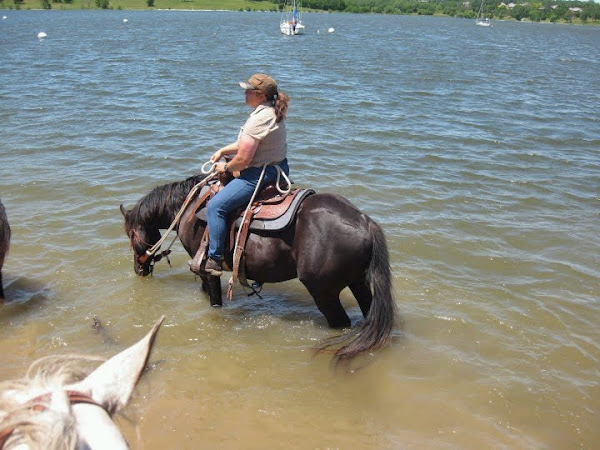
Her horse was hard to catch. Good looking black gelding, he said “here’s to you” with his tail every chance he could. I did not play predator/prey dodgy games, just walked with him wherever he went, turning away when he would accidentally face me, releasing pressure whenever I could. Surprised he was when he ended up in a corner with me right there with him. Defiantly, he walks quickly straight at me. Can’t go around you, I’ma comin’ through!
I put my hand out, stiff fingers poke him in the chest. He stops, fades back. I let him go, smiling again. You are not no bad boy, you big bluffer.
He watches me curiously as I approach, halter out openly, yes I am coming for you, and I know you know that. I will not insult your dignity by trying to hide this from you.
Gelding stands like a rock. I pet his neck and he eyes me, softly. Offer him the halter and it’s good to go.
Later I am saddling him, as he has some issues there too, and I use him to demo some foot moving thing, I don’t even remember what. It was an excuse to move that horse’s feet around, to promise him some consistency, and he heard me loud and clear. He saddled easy, feet square and still. Owner was a little surprised, I don’t guess it always goes that way.
Those two were a super neat pair, the horse stayed quiet and got softer and more relaxed as time went on.

There were no miracles, he still has brace, she still has habits to become aware of and work through but there was admirable try in that whole group and it lasted all weekend long through heat, dust, sweat and mud.

I saddle my demo horse, Slippin and feel tension oozing out of her. She’s tight and tense. I smile again. On the wall she goes and I flag her. The first couple of times, she jumps hard, finding the end of the lead and the end of her nose. Then she slows down and searches for the right answers. The clinic watches and when she does change and get softer, they can see that and why you might want such a thing before you climb up, depending on how much sand you have in your pants that particular day.
We did the ground work to learn how to watch the feet. To learn that when the hind feet hit the ground right, everything else comes along. I showed them that outside hind foot, moving away to make room for the inside hind to come across. How when that happens a horse can and will give his hip with ease. And then, later, how that maneuver shapes them up for coming back through with the front end. Do Less. You know I said that. A lot.

We discuss how you don’t do a thing with a horse, you get the horse ready and the horse does the thing. I needed to get Slippin ready to ride. I talked about having a horse change it’s eyes, how suspicious it is for a horse to have a thing on one side and then suddenly it appears on the other (such as leg coming across the saddle . . .)
I used the flag on Slippin as a demo and she was a very good student, not terribly concerned but gave us enough “before and after” for people to see what we are looking for. Great spook therapy, this is not just for young colts.


Our guy participant brought a young filly he’s raised and has been working with. She is under saddle but hadn’t been backed yet. Having ridden a few of their horses and knowing what kind of minds they have, I thought it not impossible we might get her rode before it was all said and done and so we did. First things came first though.

Her feet were STUCK. The footing was pretty deep, new arena, new sand, and we were asking some very new things of her. She would lock up and then jump forward to get clear of the deep sand. All in all, she got a little more excited than I had hoped she would but it stayed at a dull roar, she never bucked and before we quit, she had a different look on her face, and on her feet. The next morning, she was a different horse and I watched her owner handle his handfuls of rope and stick with competence and grace. Making himself ready before he got his horse ready. Making a plan.

All this time, I am showing them things and I know it’s high time I get them feeling them for themselves. ‘That is what the rest of the clinic was all about, other people’s lightbulbs. Again, these are not my stories to tell, but I watched soft feels happen when people were pretty sure they wouldn’t . . . watched people learn how that once the jaw is unlocked, it’s a heck of a lot easier to move the body, that once the hip gets under, the front can come through pretty nice. The difference in cuing one or the other.

We talked about how sending a horse builds it’s ability to go forward, and that is necessary, once you have sent, to ALLOW your horse to go!


We played some arena games, getting the horses used to the idea horses can come at them, leave them, travel by on either side, and that they could lead, follow or be in the middle without trouble.
Getting on Slippin went okay at first, but she got increasingly anxious at not being able to join the horses on the rail. I ended up putting her back on the wall until I could give her my undivided attention. We found a little trouble, but I did not correct her. I made the wrong thing not impossible, but difficult, let her run into her bit when she wanted to run off then gave her direction. Thank you, Peter


I could see the people making changes, but for me, I was learning all the things I was teaching all over again. I did too much, a bunch of times, got the horse back by doing less, each time. Went through something mildly bad, trying to get to something good. Next time, I didn’t go through the bad, just rode on and started over. It got easier and easier to get straight to the good.
And that was Day One.



 Posts
Posts


