


and I am really going to miss her. Mocha is a four year old AQHA filly raised by Eric and Doats Norby at Broken Wheel Ranch, in Sioux City, IA. If you follow my blog, they raised my beloved Slippin and Knosie, a pair of fillies I put time on as two and three year olds. Mocha is by the Two Eyed Red Buck stud that they have and I think that stud must put an incredible mind on every baby he throws, if these three are any indication. Mocha started out with an issue or two, but what horse that comes to training doesn't?
Mocha had an injury when she was two that resulted in surgery on an infected tendon and quite a bit of time spent in a cast. Norby's brought her to my place to start, last Fall, just shortly before I fell victim to the plague and had to send all my training horses, jiggedy jig back home again. Throughout my barn misadventures when we moved to Omaha this winter, they have patiently waited for me to get myself settled, then they and a friend of theirs hauled all the way down to Plattsmouth so I could finish the job I had promised.
Mocha had been handled plenty, of course, during her rehabilitation, but there was no way she could be asked to move her feet, much and she really liked that status. When she did move them, she thought nothing at all of putting them wherever she wanted them to go, and if that was on top of you, well then, it made perfect sense to her that you should just get the heck out of the way.
Not having had to do much she didn't want to, as was necessary to not upset her during that delicate healing time, it came as quite a shock to Mocha when so many things changed, and quickly at that. When I walked away and took the slack out of the lead, I expected her to step right up and follow, not pull the slack out and tow along behind like a barge stuck on sandbar. Being tied up didn't bother her one bit, but having to wear a saddle? THAT was seriously out of the question.
I did most of the warm up I normally do when I saddle for the first time. I make sure the young horse is as relaxed in their body as they can possibly be, teach them to disengage their hips over, bring their shoulders back through so I know I have at least a little control over them when I go to saddle. I desensitize around the girth and back cinch areas, hold the end of the lead around them. I release and present pressure with feel and timing to help the young horse not get troubled. I throw the rop over their backs, let them feel the saddle pad all over and see it on both sides. Mocha handled all of this okay, and setting the saddle up was not a big deal. It was not until she left and the pesky thing insisted on going with her that things got dusty.
She really didn't buck much, and not that hard either. I probably would have even stood a decent chance of riding it out, had it happened when I was on board though I am awfully glad I wasn't. Derek, who owns Log Barn Stable, and his hired hand, Jim, were watching, and their eyes were even bigger than the filly's. They thought she might present quite a handful. I laughed, and said, nope, she'll be fine. Seen a LOT worse than this!!
That idea of theirs was compounded a few days later when Mocha and I had a showdown about where the feet go. When I said, don't run into pressure, she said, okay, how about I run THROUGH it instead? I said, what a bad idea that is. She said, get out of my way, you silly insignificant human, I want to be somewhere else right now!
We went round and round. She'd run through her halter pressure, over and over again. I escalated to meet her resistance, and she escalated to meet mine. I turned her into the round pen panels and asked her to yield back a step or two. When she couldn't blow past me, she reared up, trying to swing her body over the top of me. That ran her into my stick pretty sharp, as my arm wasn't tall enough to reach that high but no way was she going to succeed in that manuever!
The hired guy had brought in some round bales and was watching this altercation with considerable interest. I am thinking to myself, holy cow, he is going to be thinking I am the meanest most abusive horse trainer ever (whack, do NOT try to run over me, WHACK do NOT rear up over the top of me, BACK UP!!). We were at this for awhile, and I am seriously questioning what I can do to help this filly figure things out. We are in the thick of it, and no way can I release pressure here, as where the release comes, so does the teaching and if you release in the middle of something that isn't going well, you'll teach that just as effectively as when you release at that perfect and proper moment.
Which . . . finally came. Almost by accident, Mocha suddenly threw her head down after running into my stick several times, and backed herself up. She is breathing heavily, eyes big and on me, ears straight forward. I throw down the rope (reminiscent of when I was working Jessica's Wildfire filly), spin around and walk away, releasing pressure in as large a picture as I possibly can. YES! THIS is the RIGHT answer!!
Mocha watches me intently to see what I will do next. As she relaxes and straightens her body position, I slowly approach. I make myself as friendly and non threatening in every aspect of my body language that I p0ssibly can. When I reach her, I hold out my hand, palm down in a cup shape I have heard called the "horseman's handshake." I let her reach out and touch me first, then I rub and rub her. She's sweaty and enjoys the contact and the reassurance.
We turned a corner that day. Still had things to work out, but she no longer dragged her feet on the halter rope, was no longer pushy and disregarding of my space. Jim said he was watching not to see if I was going to hurt the filly but if he needed to call 911 for me!! Aw heck, Jim, it wasn't all THAT bad, LOL! It's been fun, having those guys watch this filly progress into the nice horse I was very sure she would be, from the start, knowing her breeding and all.
The first time I got on her, she was very unsure and tense. I let her move around until she relaxed, didn't ask much of her and got down. I fixed some more things from the ground. Another colt starter might have just ridden her through and been fine. I do what I do, and it seems to turn out okay. Rode her again, a few days later with MUCH better result. In the meantime, I have been working on keeping her balanced in her movement, watching for all four corners to be reaching equally, walk, trot and canter on the 12 foot line. We work circles (I never lunge, hate seeing horses run around in mindless circles that are not teaching them anything), and I bump her if she pulls on me, continuing to reinforce the idea of being light and responsive on the line, just like I am soon going to want her to be light and responsive on the rein. I send her over the bridge, help her gain confidence by using my plastic sacks on the end of a stick. I bring them from the ground, straight up the shoulder, a tip I got from my good friend, Colleen Hamer. I run it over the side of the saddle so she can see it from the eye on the side I am not on. I run it over her rump, down her legs, as if something is falling off the saddle. She gets calm and good with all of this. Time to ride.
A young gal is also training out at Log Barn, Miss Jesse James, from out the wild west, Broken Bow, NE way. I enlist her aid, and ask her if she wouldn't mind being a passenger for me while I send the filly around and get all three gaits. She says sure (oh for the courage of youth!!), I get on Mocha first (oh wait, maybe I don't that night, but had been on her before, and was very sure we'd not run into problems.) I give Jesse a line from the halter, we make a game plan in case things don't go well, and I send them off at a walk. We pick up the trot, and eventually get the canter, going that way. I think we got Mocha tired, in the deep sand, as we got the trot the other way, but she was straining pretty hard when I asked for the lope and I didn't push it. I really like having someone to passenger while I am the gas pedal. It makes things easier all the way around.
After that, it's just been a matter of getting the rides on and the teaching commenced. We've ridden in the arena, rode over the bridge, which of course she had no problem with, been down the road a little and she got hauled over to Chance Ridge Event Center when I rode a group lesson with Brenda Messick who is introducing some really cool concepts with Centered Riding.
The Event Center is a wonderful place to ride. The arena is huge, nicely footed, there are roping boxes, bucking chutes and always something going on in the back alley where the livestock lives, oh yeah, and a tarp covered mechanical bull in another corner! My broke mare, Ginger, looked askance at a couple of things. Not Mocha. First, I ponied her around to give her a good look at her surroundings, and when I got on, I dropped the reins and let her go see whatever she needed a second take on. She makes a beeline for the alley that goes in back to the cattle pens. Not one bit afraid, Mocha drinks in the sights and sounds of cattle. Wow, she's neat!
Riding there went well, and I love how solid and confident this horse feels under me. She's not a spook, has her brain firmly between her ears at all times, and just does not seem to get rattled by much of anything. The other night, Jesse rode Mocha and I rode Two Sox, a gelding I have in training, and we just played around in my big dry lot. It was about riding up and down steep little hills, stopping, turning, backing, going where WE wanted to go, even though it was their home and the other horses were happily munching at the round bale while they had to work. Neither colt got at all worried or troubled, which was nice to see.
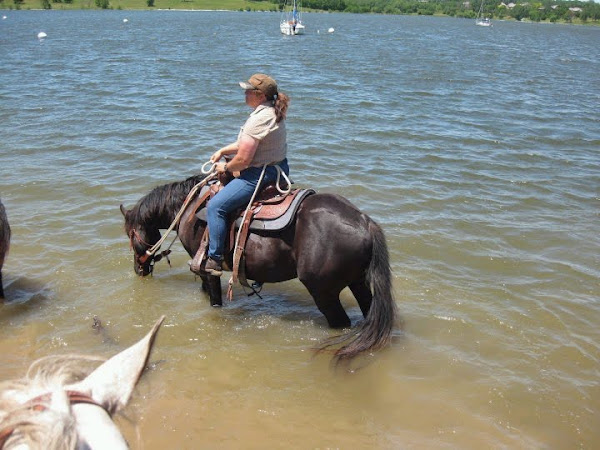
Yesterday, Derek took some moments from his busy day and shot a few photos for me. I have a few from the very early days when Corie came over to watch Soxie, and now these. The filly has come a long way, which of course, is always the goal. I think she can go home and do a good job for my friends, whether it's trail riding, gathering cattle or maybe finding a new home in the world to please the next set of owners. She needs her continuing education, but I couldn't be happier with the start. Only 30 days, and that, a broke horse does not make, but she handles nicely, gives to her bit, and when you ask something with a rein, she understands it means for a foot to move, whether it's forward, backward or laterally.
Now for the commercial. I am accepting limited bookings for June, July and August. I am only taking on three outside horses, as I am going to concentrate on lessons and clinics. This week, I'll be traveling to Georgia and riding in a five day clinic to get an accreditation as Riding Instructor with the American Association of Horsemanship Safety. I am very excited about this new direction in my life. My first love will always be helping horses, but unless I can help the people, it truly is not as good.
Contact me for more info on this stuff if you are interested. I need five paid in advance riders to host a clinic and we can do it at Log Barn Stables wwwlogbarnstables.com or your facility if you choose!
Thanks and happy trails!!



 Posts


Let's Get to It
6 years ago


